


Demolition rarely gets the spotlight. In Minneapolis, the wrecking phase has become a public test, shaped by neighborhood expectations, and sharper health and safety oversight.
A key catalyst was the Smith Foundry teardown in East Phillips. The Minnesota Pollution Control Agency notes the facility stopped operating in August 2024 and that a demolition notice was submitted in February 2025. When demolition began later that month, residents and neighborhood leaders told reporters they were caught off guard and worried about dust and pollution risk. After dust problems, the city said its Health Department monitored the site daily and stopped the contractor from working if winds were above 15 miles per hour.
For developers, the lesson is simple: a Minneapolis demolition permit is no longer just paperwork. It’s a process you plan, staff, and explain.
The baseline still matters
- Minneapolis, MN calls its demolition authorization a “wrecking permit.”
- The city says you must get one before demolishing a commercial building or a one or two-family dwelling, and you need to hire a licensed wrecking contractor to do the work.
- Those basics remain. What’s changing is the city’s appetite for earlier notice and clearer controls for sites that can generate nuisance conditions.
What’s getting tougher
1. More lead time and stronger notice expectations
Draft ordinance circulated in late 2025 adds a notification requirement that begins at least fifteen calendar days before wrecking starts. If you’ve relied on fast mobilization after closing, that buffer forces a reset.
Notice-distance is important. In the historic preservation workflow, the city states that it sends notice to property owners within 350 feet before a Heritage Preservation Commission public hearing.
In practice, it’s safer to assume that more people will hear about your demo early, and that questions will arrive earlier in your process.
2. Environmental mitigation plans, plus neighbor meetings
The 2025 ordinance update describes requiring an environmental mitigation plan for certain qualifying demolitions and requiring a neighborhood meeting at least five calendar days before wrecking begins for those applicants.
That pushes the work upstream. Dust control, runoff controls, truck routing, and site security cannot live only in a superintendent’s head. They need to be written, owned, and ready for public scrutiny.
3. Wind and dust controls that can stop your schedule
Most project teams already plan around snow and rain. Minneapolis is signaling that wind and visible dust can be stop-work triggers too. Build that into your sequencing and into your contracts, so everyone knows what happens when a high-wind day hits.
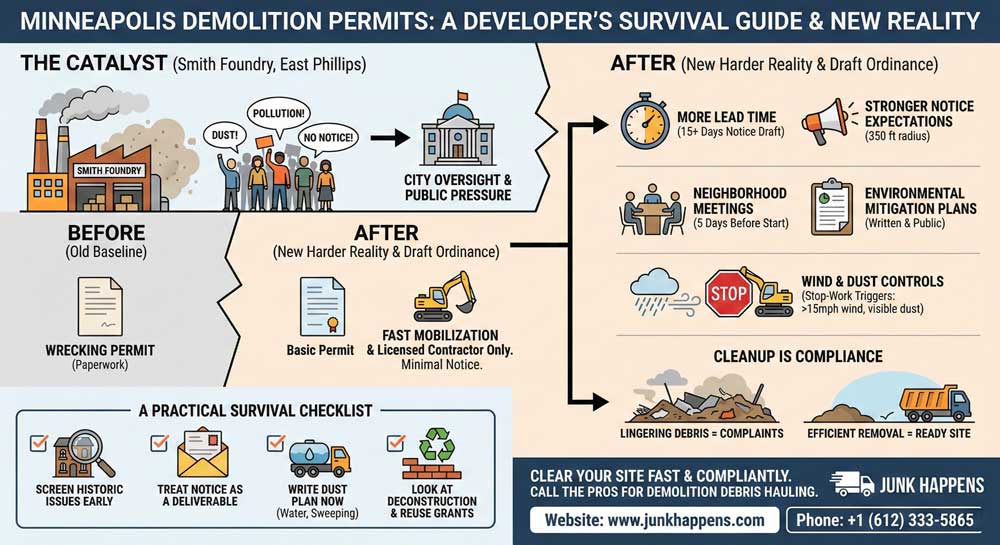
A practical survival checklist
- Screen for historic issues on day one. The city notes that approval to alter or demolish a historic property can take many weeks. If you’re anywhere near a designation or potential landmark, talk to preservation staff early, even if your plan feels straightforward.
- Treat notice as a deliverable. Draft the letter, map the radius, verify owner and tenant contacts, and set up a single point of contact for questions. The goal isn’t to win a debate. It’s to show you’re organized and reachable.
- Write the dust plan before you need it. Identify water supply, sweeping frequency, truck routes, covered loads, and fencing. Add a wind policy that matches how the city has handled high-profile demolitions.
- Expect deeper diligence for older or industrial sites. A Phase I environmental assessment won’t be required on every parcel, but it can keep you from being surprised by a mitigation-plan conversation on a tight timeline. The Smith Foundry record is a reminder that community trust and environmental history travel with the land.
- Look hard at deconstruction and reuse. Hennepin County offers building reuse grants for projects that reuse and recycle materials rather than relying on mechanical demolition alone. Even when you don’t qualify, the criteria are a helpful template for waste diversion expectations.
Cleanup is part of compliance now
Neighbors may never read your permit file, but they will notice dust, tracked soil, and debris that lingers. A plan for demolition debris removal reduces what can become airborne and shortens the window for complaints.
There’s also the non-structural mess: abandoned contents, loose fixtures, and mixed materials that can bog down the transition from wrecking to excavation.
On many projects, that’s where reputable junk removal services make the difference between a site that’s ready for the next trade and a site that keeps bleeding days.
Also Read: The Impact of Construction Waste on Minnesota’s Air and Water Quality
So, what is next?
Before you submit, write the demolition plan in plain English: what is coming down, when, what controls will be in place, and who neighbors can call if something goes wrong. If your team can answer that calmly and clearly, you’re aligned with where Minneapolis is heading.
Clear your site fast after a tear-down: Junk Happens handles demolition debris hauling with heavy-duty trucks and cleans up before leaving, serving the Minneapolis–St. Paul metro. Request an estimate and schedule your pickup at https://www.junkhappens.com/