



Office cleanouts, remodels, and warehouse reorganizations usually start with a simple goal: get the clutter out. Many owners schedule commercial junk removal in Minnesota to move bulky items fast and keep a project on track. That approach works well for furniture, fixtures, scrap lumber, and general debris. It breaks down when the “junk” pile includes chemicals, aerosols, or mystery containers, because hazardous waste follows a different set of rules and a different disposal path in Minnesota.
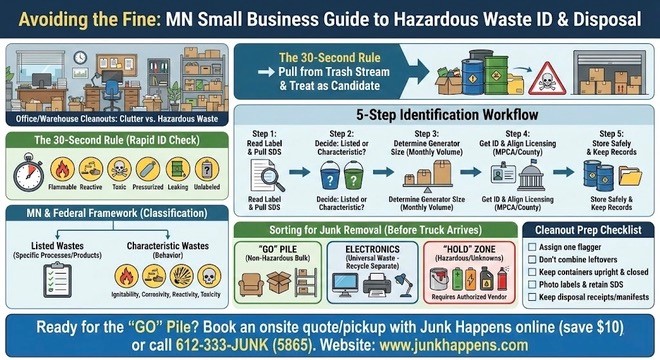
The 30-second rule
If a material is flammable, corrosive, reactive, toxic, pressurized, leaking, or unlabeled, pull it out of the trash stream and treat it as a hazardous-waste candidate until you confirm otherwise. Under federal hazardous waste rules, a solid waste becomes hazardous if it is specifically listed or if it shows one or more hazardous characteristics.
What counts as hazardous waste in Minnesota
Minnesota follows the federal framework for identifying hazardous waste:
- Some wastes are “listed” by regulation, and
- Others are “characteristic” wastes based on how they behave.
Characteristic wastes fall into four buckets: ignitability, corrosivity, reactivity, and toxicity.
For small businesses, the tricky part is that hazardous waste is not limited to leftover product. Solvent-soaked rags, spent aerosol cans, chemical spill cleanup material, and residues in containers can also create compliance obligations depending on how they were used and managed.
A simple identification workflow businesses can repeat
Step 1: Read the label and pull the SDS
If a product has a current label and Safety Data Sheet (SDS), you already have a strong starting point.
The SDS often flags flammability, extreme pH, instability, or health hazards that correlate with hazardous-waste characteristics.
If the label is missing or unreadable, treat the material as “unknown” and set it aside for identification rather than guessing.
Step 2: Decide whether it is listed or characteristic
According to EPA, listed wastes come from certain processes or discarded commercial chemical products, while characteristic wastes show ignitability, corrosivity, reactivity, or toxicity.
Step 3: Determine your generator size
In Minnesota, your waste generator category is based on what you generate each calendar month, and it affects licensing and reporting.
Step 4: Get your ID and align with your licensing path
Minnesota Pollution Control Agency (MPCA) explains that reporting and licensing depend on generator status and that requirements may run through MPCA or a metro county program.
Step 5: Store safely and keep records
Clear labels, closed containers, and basic separation of incompatible materials help prevent incidents and support your paperwork later. MPCA’s hazardous waste program emphasizes annual reporting and licensing for generators subject to those requirements.
What junk removal companies in Minnesota can’t take
Junk removal is a great fit for non-hazardous bulk, but crews are not a replacement for hazardous-waste vendors. Junk removal services cannot take hazardous materials and other items such as paints, solvents, oil, and batteries. That is typical for junk removal providers because regulated waste requires specific packaging, transport rules, and approved destinations.
A simple way to avoid a refused pickup is to stage items in three zones before the truck arrives:
- “Go” pile: Furniture, non-hazardous construction debris, shelving, cardboard, and general clutter
- Electronics and universal-type items: Computers, printers, and lamps, kept separate for proper recycling
- “Hold” zone: Chemicals, pressurized containers, leaking items, and unknowns that need verification
That sort takes less time than rescheduling a pickup, and it keeps your staff safer during the cleanout.
Cleanout prep checklist for Minnesota small businesses
Keep this short list in your job folder so it actually gets used:
- Assign one person to flag questionable items before loading starts.
- Don’t combine leftovers to “save space.” Mixing can create reactions and raise disposal costs.
- Keep containers upright, closed, and labeled.
- Photograph labels and retain SDS files for anything staged in the hold zone.
- Keep disposal receipts, shipping papers, or manifests from authorized handlers.
Where to go when junk removal can’t take it
When regulated materials show up, the safe route is an authorized hazardous-waste vendor or facility. MPCA explains that generators must report (when required), pay applicable fees, and obtain licensing for the subsequent year, with metro counties handling many generator interactions in the Twin Cities area.
Ready to clear out your office or shop without last-minute surprises? Book an onsite quote/pickup with Junk Happens online (and save $10) or call 612-333-JUNK (5865).
Also Read: Junk Removal Service vs Dumpster: Which One Fits Best for Your Project?
Frequently Asked Questions:
1) How do I know if my business waste is hazardous in Minnesota?
Start with the label and the Safety Data Sheet. If the waste is listed by regulation or it shows ignitability, corrosivity, reactivity, or toxicity, it can qualify as hazardous waste. When a container is unlabeled, isolate it and identify it before disposal.
2) Can junk removal companies take paint, solvents, or batteries from a business?
Often, no. Junk removal companies cannot take hazardous materials and specifically call out paints, solvents, oil, and batteries among excluded items. That doesn’t mean your cleanout has to stop. It means you should separate regulated materials early and use an approved hazardous-waste outlet for those items while junk removal handles the rest of the bulk.
3) Do small businesses need a hazardous waste ID number in Minnesota?
Many do, depending on what they generate and how much. MPCA suggests obtaining a hazardous waste identification number after you evaluate the waste and determine generator size. If your business generates hazardous waste on an ongoing basis, the ID number supports proper tracking, licensing, and reporting requirements tied to your generator category.
4) I’m in the Twin Cities metro. Do I deal with MPCA or my county program?
MPCA explains that metro county hazardous waste programs serve generators in Anoka, Carver, Dakota, Hennepin, Scott, Ramsey, and Washington counties, while MPCA regulates and assists generators in Greater Minnesota.Practically, that can change where you submit reports and how you manage licensing. Hennepin and Ramsey, for example, publish their own licensing instructions for businesses in their counties.
5) What records should I keep to reduce the risk of fines?
Keep what proves you identified the waste and sent it to an authorized manager: SDS files or photos of labels, notes on how you determined generator size, and disposal paperwork such as receipts or manifests from approved handlers. MPCA emphasizes annual reporting and licensing for hazardous waste generators where applicable.