


A dead microwave feels like the easiest kind of clutter: unplug it, drag it out, toss it. In reality, microwave disposal sits in an awkward category between “regular trash” and “special handling,” especially in Minnesota. The unit is part metal, part electronics, and built to take a beating, which makes it tough on dumpsters, trucks, and sorting equipment.
If you manage property, run a small business, or just want to clean out a kitchen without creating a mess down the line, it helps to know what local programs expect and why they exist.
Why a microwave is not “just junk”
Microwaves are a mash-up of steel, wiring, circuit boards, plastic, and glass. That mix matters.
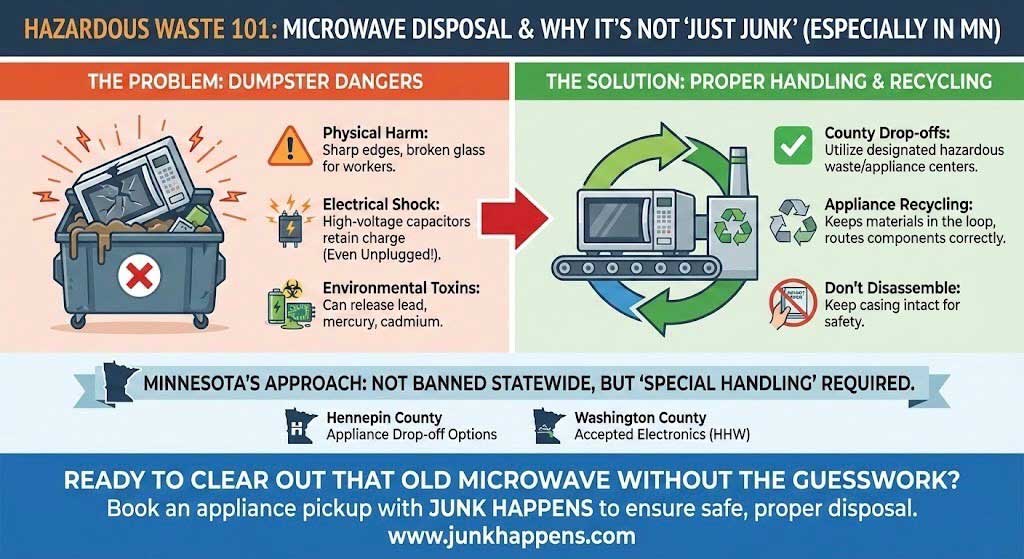
When a microwave gets crushed in a dumpster or compacted in a truck, sharp edges and broken glass become a safety issue for anyone handling the load. It also increases the chance that small electronic parts break apart and scatter in the waste stream.
Electronics are treated cautiously for another reason: they can contain toxic metals and other contaminants when mishandled or processed informally. The U.S. Environmental Protection Agency notes that unsafe e-waste practices can expose people to contaminants such as lead, mercury, and cadmium.
E-waste disposal in Minnesota: what’s actually required
Minnesota’s best-known electronics rule is the ban on dumping devices with cathode ray tubes (older TVs and monitors) in mixed municipal waste. That rule does not automatically cover every household electronic item.
Still, “not banned statewide” is not the same as “welcome in the dumpster.” Cities, counties, and haulers set their own accepted-item lists. Minneapolis, for example, points residents to Hennepin County drop-off options for electronics and appliances.
In practice, many Minnesota programs steer microwaves toward appliance/electronics channels because that is where staff, containers, and downstream partners are set up to handle them.
The hidden safety issue: don’t take it apart
A broken microwave can tempt a DIY teardown. It’s usually a bad idea unless you are trained.
Manufacturer service manuals warn that a high-voltage capacitor can retain an electrical charge even after the unit stops running and is unplugged.
For most households, the safest move is to keep the casing intact and focus on getting the whole unit to an approved drop-off or recycler.
Minnesota-friendly options that work
The best option depends on where you live and how you plan to transport it. These are common paths in the Twin Cities metro and nearby counties.
County drop-offs and environmental centers
County facilities are often the most straightforward choice because they are designed for problem materials.
Washington County’s household hazardous waste and electronics program explicitly lists microwaves among accepted electronics. Hennepin County also accepts microwaves through its appliance drop-off guidance.
Before you go, check residency rules, hours, and any fees. A quick look can save a wasted trip.
Keep the materials in the loop
Even if you are mainly focused on getting the microwave out of your kitchen, recycling channels have a practical upside: they recover metal and route remaining components more appropriately than mixed trash.
Minnesota’s broader messaging around appliance recycling reflects that idea, especially for items with components that require careful handling.
When a pickup service is the better call
- A single microwave is manageable. The real-world situation is often a microwave plus a pile: cabinets, flooring scraps, a worn-out chair, and boxes you meant to unpack three moves ago.
- That’s where junk removal in Minnesota can be the cleanest option, especially if you want one scheduled pickup and clear accountability for where items go.
- If you hire help, ask one direct question: “Do you separate appliances and electronics from landfill trash?” (Good operators already do.)
- If you are a landlord or handling an estate cleanout, appliance removal also reduces the chance that tenants or helpers try to force bulky items into shared dumpsters, where they can create conflicts with property rules and haulers.
For larger cleanouts, junk hauling can also help you keep the site safer by clearing heavy items early, leaving less clutter for trips and falls.
Ready to clear out that old microwave without guessing where it should go? Book an appliance pickup with Junk Happens and their crew will haul it from your home and route it through their appliance recycling and disposal process.
Also Read: The Untold Environmental Impact of Proper Appliance Disposal
Frequently Asked Questions
1) Can I put a microwave in my apartment dumpster in Minnesota?
Some buildings allow it, but many do not. Even when it is permitted, dumpsters are rough on electronics: glass breaks, metal bends, and the unit can jam compacting equipment. Minneapolis encourages residents to use county drop-offs for electronics and appliances, which is a strong signal that dumpsters are not the preferred route.
2) Where can I drop off a microwave near Minneapolis or the Twin Cities?
Start with county facilities. Hennepin County’s disposal resources include drop-offs that accept appliances, and its appliance list includes microwaves. Washington County also lists microwaves under accepted electronics at its environmental center program. Always verify hours and residency rules before driving.
3) Is a microwave considered hazardous waste?
A microwave is often treated as an electronic appliance rather than classic household hazardous waste like paint or pesticides. Still, electronics can involve contaminants when broken or processed improperly, which is why many programs handle them through special collection. The EPA has warned that unsafe e-waste handling can expose people to lead, mercury, and cadmium.
4) Is it safe to take apart a microwave before recycling?
For most people, no. Service manuals warn that high-voltage components can hold a charge even after the microwave is turned off and unplugged. Leaving the unit intact reduces the risk of electrical shock and keeps sharp internal parts contained during transport.
5) Can I bring a microwave to a scrap metal recycler?
Sometimes, yes, but rules vary. Hennepin County emphasizes preparation requirements and notes you cannot remove non-metal parts on-site at drop-off facilities. Call the recycler first and describe the item; they will tell you if they accept it whole.